Keeping the Lights On: HA, DR, and Business Continuity
Category: Article / Solutions
Published on: December 16, 2025
Keeping the Lights On: HA, DR, and Business Continuity
In the digital age, "downtime" is a dirty word. Whether you are a global enterprise or a growing startup, the expectation is simple: your services need to be available 24/7. But what happens when a server fails? Or worse, when a natural disaster strikes your data center?
Today, we're breaking down three critical concepts—High Availability (HA), Disaster Recovery (DR), and Active/Passive configurations—using both technical diagrams and simple, real-world analogies.
1. The Technical Perspective
For our IT architects and engineers, the architecture of resilience is all about redundancy and replication. As illustrated in our technical breakdown below, these systems are designed to eliminate single points of failure.
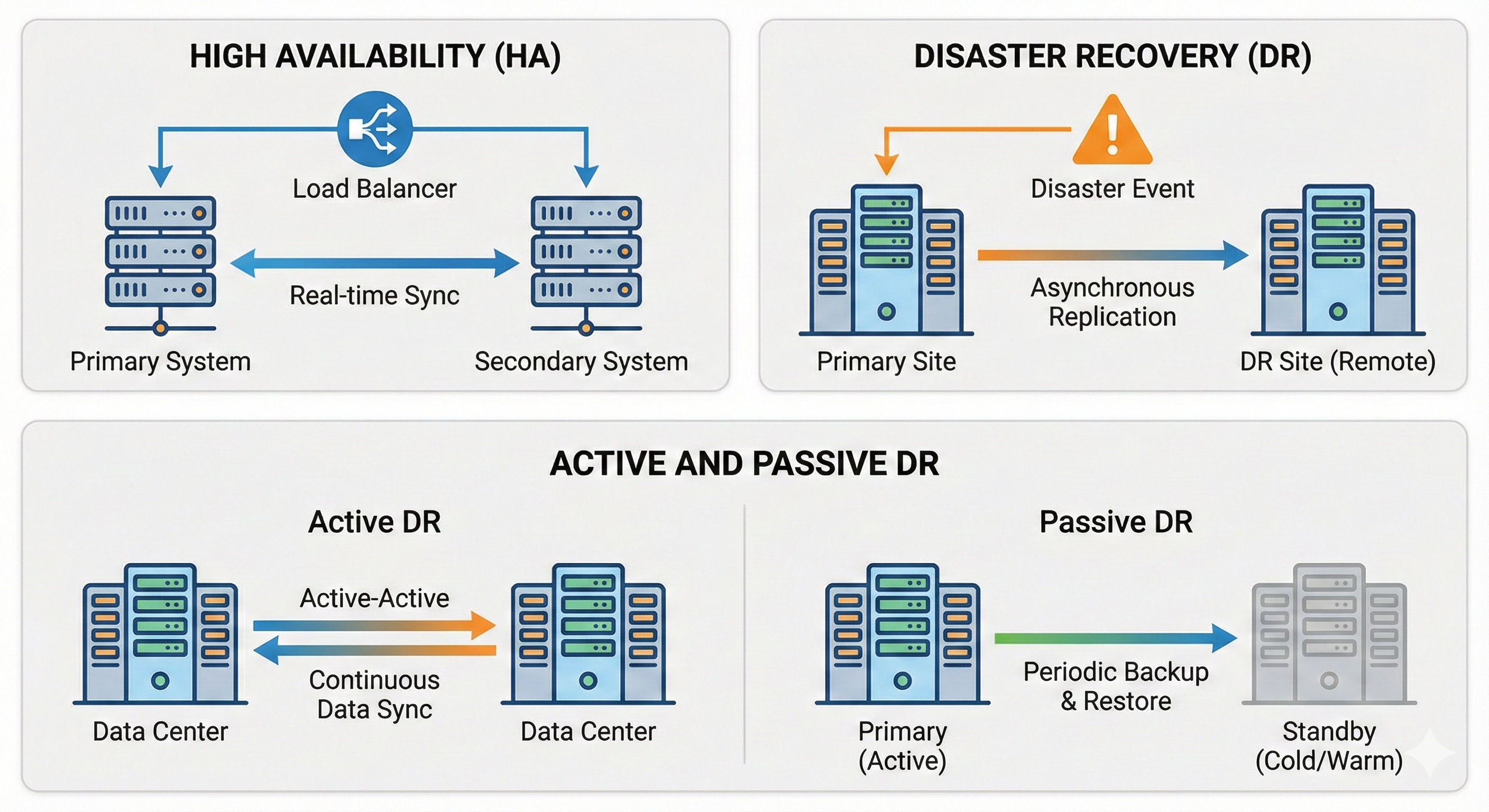
Shows servers, load balancers, and replication streams.
- High Availability (HA): This is about automatic failover. Notice the "Load Balancer" in the diagram? It directs traffic to healthy servers. If "Primary System" fails, the "Secondary System" picks up the slack instantly. Users never notice a thing.
- Disaster Recovery (DR): This is about site survival. If the entire "Primary Site" goes dark (power outage, flood), data is asynchronously replicated to a "Remote DR Site." It takes a bit longer to switch over, but your data survives the catastrophe.
2. The Layman’s Perspective (Simply Put)
Not everyone speaks "TCP/IP" or "Asynchronous Replication." To explain this to your CEO or stakeholders, we need to step away from the server rack and look at everyday life.
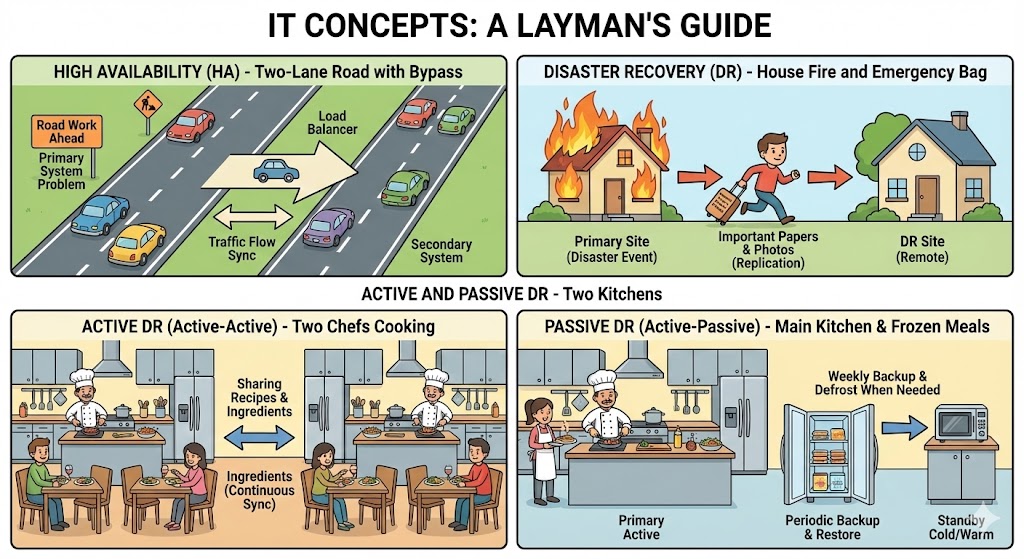
Shows everyday scenarios like spare tires or backup generators.
🚗 High Availability is a Spare Tire
Imagine you are driving a specialized car with run-flat tires. If you get a puncture, you don't stop. You keep driving. The car is designed to handle the failure instantly so your journey (the service) isn't interrupted. That is High Availability.
🚑 Disaster Recovery is the Ambulance & Insurance
Now, imagine the car is totaled. Run-flat tires won't help you now. You need a completely new car. You call your insurance, they process the claim, and eventually, you get a replacement vehicle. It takes time, and it's for major events only. That is Disaster Recovery.
3. Active vs. Passive: The Strategy Behind the Setup
When setting up these safety nets, you generally have two strategic choices, often referred to as Active/Active or Active/Passive.
🔵 Active - Passive (The "Backup Generator")
In this scenario, you pay for two servers, but only use one. The second one sits idle (Passive), waiting for the first one to break.
Analogy: A home generator. It sits silently in your garage 364 days a year. It only turns on when the main power grid fails.
🟠 Active - Active (The "Multi-Lane Highway")
Here, both servers are running and taking traffic at the same time. If one fails, the other just takes on the extra load.
Analogy: A supermarket with two checkout lanes open. If one cashier goes on break, the line effectively moves to the other cashier. It’s more efficient because you are utilizing both resources you pay for.
Summary: Which Do You Need?
| Feature | High Availability (HA) | Disaster Recovery (DR) |
|---|---|---|
| Goal | Prevent downtime during minor failures. | Recover business after a major catastrophe. |
| Speed | Instant (Seconds). | Slower (Minutes to Hours). |
| Distance | Local (Same Data Center). | Remote (Different City/Region). |
At TechnoPlanet Enterprise, we believe the best infrastructure strategy uses a blend of both. Use HA to keep your customers happy day-to-day, and have a robust DR plan to ensure your business survives the unexpected.
Contact TechnoPlanet for an Audit